Dear Anna Makanju, Bret Taylor and the OpenAI Foundation Civil Society & Philanthropy Team,
Good Morning, the Sun is shining in Colorado!
I am the founder of the JanuaryAI Project (JAI), an emerging civil-society initiative built around a straightforward proposition:
AI should advance the human condition—and humanity should advance alongside AI.
Our vision is to deliver abundance and AI for Good for All. JanuaryAI is being developed as a new kind of civic institution through which everyday people, technologists, educators, nonprofit and community leaders, philanthropists, entrepreneurs, government and industry can participate in determining how AI can produce measurable public benefit.
Our mission is: Discover disruption, challenges and opportunity. Innovate and orchestrate solutions that aid humane transition. Advance individual well-being and happiness.
We are beginning this work in Colorado through the JanuaryAI Project, our broader majaii community, and a community planning process we call JAI Meeting of the Minds.
Meeting of the Minds
Meeting of the Minds is designed to move a community from conversation to coordinated action. Citizens and subject-matter experts consider how AI can positively affect education, health and wellness, energy, manufacturing, economic opportunity and other areas of everyday life.
The underlying principle is deliberately democratic:
1 PERSON / 1 VOTE
As community members post ideas, debate alternatives, contribute expertise and identify problems, promising ideas can begin to develop community consensus. Consensus initiatives can become proposed JAI Programs. Citizen Members can then vote on whether JanuaryAI should authorize resources to launch a program, measure its results and determine whether a successful solution can be scaled and deployed more broadly.
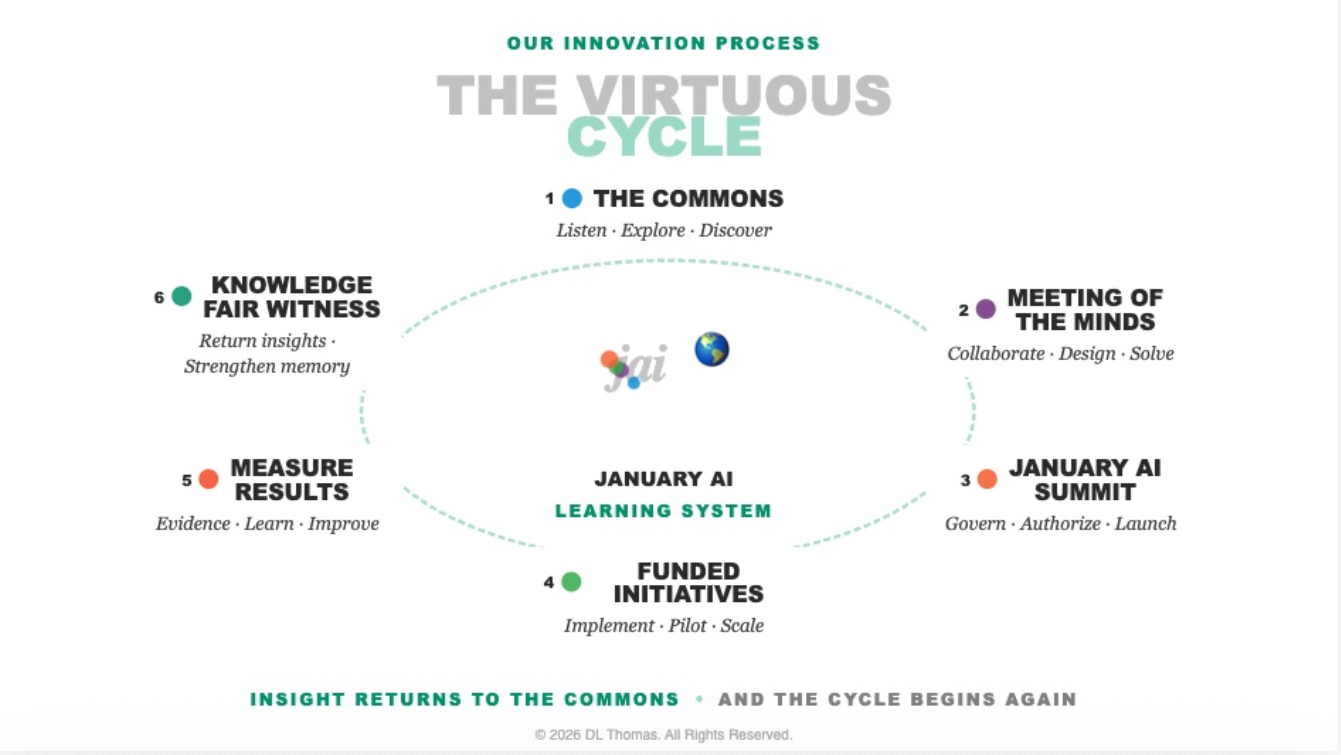
We call this process the Virtuous Cycle:
DISCOVER → DISCUSS → BUILD CONSENSUS → VOTE → FUND → ACT → MEASURE → LEARN → SCALE → DISCOVER AGAIN
The objective is democratic coordination of AI for Good. Rather than assuming that the priorities of the AI transition should be determined exclusively by technology companies, government, philanthropy or experts, JanuaryAI asks another question:
Can everyday citizens be given a meaningful democratic mechanism for helping determine where AI should be applied for public benefit?
We believe they can—while still bringing the expertise, capital and institutional capabilities of government, industry, philanthropy, academia and civil society into the process. That creates another important element of the Virtuous Cycle: collaboration between what we describe as virtuous citizens and responsible capitalists.
Funding for initiatives can potentially combine citizen investment and philanthropy with industry and government resources. Different participants contribute different forms of value, but the objective remains shared: identify common ground and convert it into measurable action.
This leads to a principle that is becoming central to JanuaryAI:
Rather than research leading eventually to action, action itself can become research.
A community identifies a problem. It develops a potential AI-enabled solution. Citizens authorize an experiment. Partners contribute expertise and resources. The program is deployed. Results are measured. Results produce valuable knowledge. Successful solutions can then be improved, replicated and scaled. That knowledge returns to the community and begins another Virtuous Cycle.
Why Colorado
Colorado provides an unusually interesting environment in which to begin testing this model. Through JAI Meeting of the Minds, we intend to explore how citizens, educators, government, philanthropy, technology companies and responsible private enterprise can collaborate around practical AI-for-Good initiatives.
Colorado Attorney General Phil Weiser's perspective on education, technology, public policy and productive public/private partnerships can contribute an important real-world perspective to that conversation.
The larger question for JanuaryAI is not simply how resources should be allocated. It is whether citizens, government, philanthropy, educators, technology companies and responsible private capital can develop better mechanisms for collectively discovering, testing and scaling beneficial uses of AI.
Why I am contacting the OpenAI Foundation
I have been studying the OpenAI Foundation's work in AI for Civil Society & Philanthropy, particularly its emphasis on putting AI to work on real community challenges, helping civil-society organizations adopt AI responsibly, and developing infrastructure and lessons that can benefit the broader social sector.
There appears to be meaningful common ground between those objectives and what we are attempting to build with JanuaryAI. At this stage, I am not approaching the OpenAI Foundation with a grant request. I would instead like to begin a conversation.
I would value the opportunity to introduce JanuaryAI, learn what your team is discovering as you develop the Civil Society & Philanthropy initiative, and understand where an emerging organization such as ours might contribute. The question I would particularly like to explore with you is:
Could democratic community coordination become another useful component of the infrastructure for AI for Good?
JanuaryAI and Meeting of the Minds could provide a real-world environment in which to investigate that question—starting in Colorado. Rather than arrive with a predetermined proposal, I would prefer to listen first.
I would welcome a conversation with you or an appropriate member of the Civil Society & Philanthropy team about the Foundation's priorities, the problems you believe deserve greater attention, and whether JanuaryAI's developing community, democratic coordination model and Virtuous Cycle could contribute to the work you are undertaking.
Thank you for considering the introduction.
Warm regards,
DL Thomas
Founder, The JanuaryAI Project | majaii
VISION Deliver abundance and AI for Good for All.
MISSION Discover disruption, challenges and opportunity. Innovate and orchestrate solutions that aid humane transition. Advance individual well-being and happiness.
© 2026 DL Thomas. All Rights Reserved.